
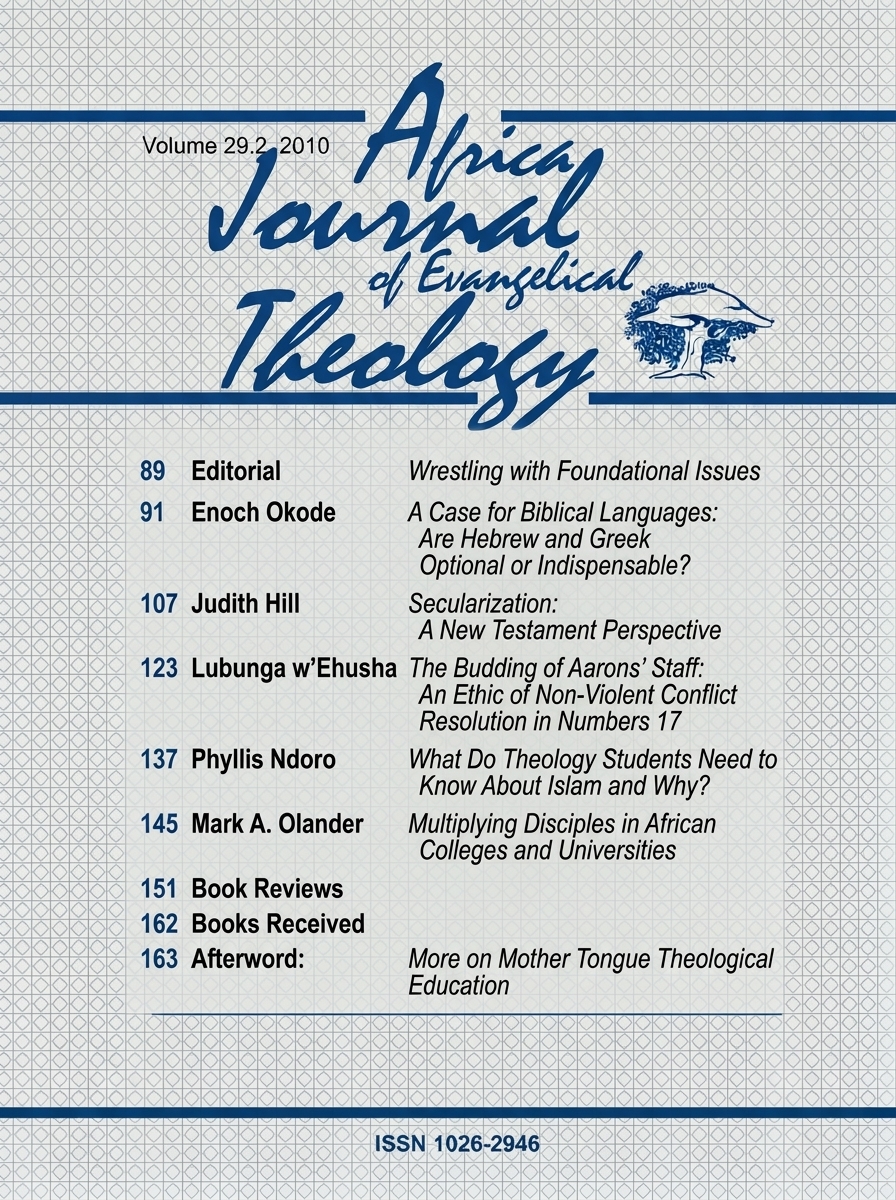
The Budding of Aaron’s Staff:An Ethic of Non-Violent Conflict Resolution in Numbers 17
Abstract
AbstractThe story of Aaron’s budding staff in Numbers 17 constitutes the final episode of a narrative marked by violence among the people of God, involving both human and divine participants. The revolt initiated by Korah in Numbers 16 created hostility between two rival groups: Moses and Aaron on one side, and other Israelite leaders and the people on the other. The violent manner in which the conflict was initially addressed resulted in the death of thousands of Israelites. However, the narrative demonstrates that violence could not resolve the underlying problem. Instead, the conflict was ultimately addressed through a nonviolent procedure involving the testing of the family staffs. This raises important questions concerning the relationship between God and violence in the Old Testament, particularly within the Exodus narrative. This paper explores how the account of Aaron’s budding staff contributes to an understanding of the tension within the biblical text, particularly the apparent contrast between a God who sanctioned the death of thousands of Moses’ opponents and the same God who initiated a nonviolent solution to Korah’s revolt.
Downloads
References
Anstey, Mark. Negotiating Conflict: Insights and Skills for Negotiators and Peacemakers. Kenwyn, SA: Juta & Co., 1997.
Arnold. "קרב," in Willem VanGemeren (ed.), New International Dictionary of Old Testament Theology and Exegesis, Vol. 3. Cumbria: Paternoster Press, 1997, pp. 976-978.
Beck, Robert R. Non-Violent Story: Narrative Conflict Resolution in the Gospel of Mark. Maryknoll, NY: Orbis Books, 1996.
Brown, Dale W. Biblical Pacifism. Nappanee, IN: Evangel Publishing House, 2003.
Brown, Francis, S. R. Driver, and Charles A. Briggs. The Brown-Driver-Briggs Hebrew and English Lexicon. Peabody, MA: Hendrickson Publishers, 1999.
Brown, Raymond. The Message of Numbers. The Bible Speaks Today; Leicester: IVP, 2002.
Collins, John J. "The Zeal of Phinehas: The Bible and the Legitimation of Violence." Journal of Biblical Literature, Vol. 122, No. 1 (2003), pp. 3-21.
Cowles, C.S. "The Case for Radical Discontinuity," in C.S. Cowles, Daniel L. Gard, Stanley N. Gundry, and Eugene H. Merrill, Show Them No Mercy: 4 Views on God and Canaanite Genocide. Grand Rapids: Zondervan, 2003.
Dear, John. The God of Peace: Toward a Theology of Non-Violence. Maryknoll, NY: Orbis Books, 1994.
Fretheim, Terence E. "I Was Only a Little Angry: Divine Violence in the Prophets." Interpretation, Vol. 58, No. 4 (October 2004), pp. 365-375.
Gray, George Buchanan. A Critical and Exegetical Commentary on Numbers. International Critical Commentary; Edinburgh: T & T Clark, 1903/2003.
Middleton, J. Richard. "Created in the Image of a Violent God?: The Ethical Problem of the Conquest of Chaos in Biblical Creation Texts." Interpretation, Vol. 58, No. 4 (2004), pp. 341-355.
Mitchell, Marie André. Shabbat Table Talk: Parashat Korach—Erev Shabbat, 18 June 2004 (dealing with Numbers 16:1-18:32). Bat Kol Institute. http://www.batkol.info/wp-content/uploads/2011/11/paras19062004.pdf
Ryken, Leland, James C. Wilhoit, and Tremper Longman III (gen. eds.). "The Land Flowing with Milk and Honey," in Dictionary of Biblical Imagery. Leicester: IVP, 1998, p. 488.
Downloads
Published
Issue
Section
License
Copyright (c) 2010 Scott Christian University

This work is licensed under a Creative Commons Attribution 4.0 International License.