
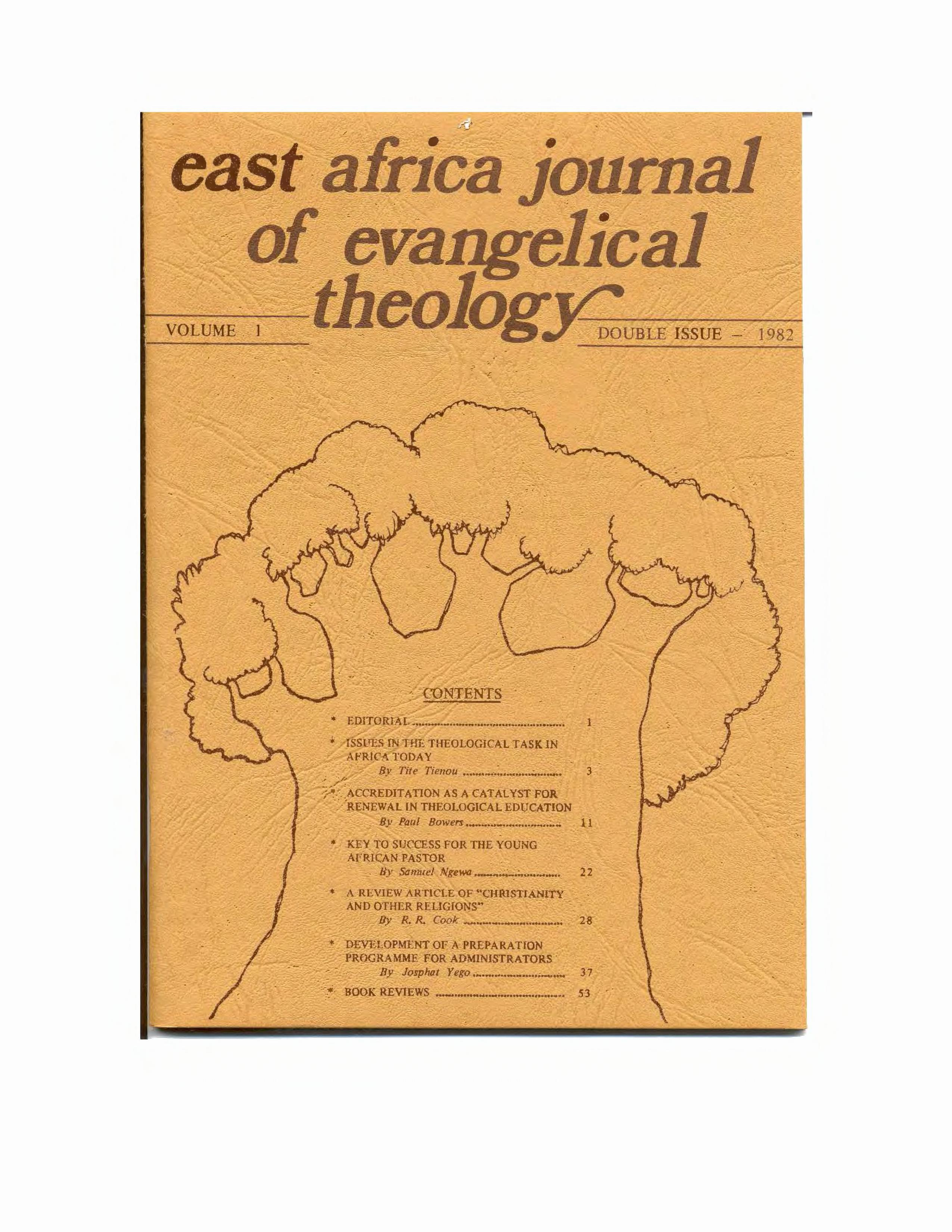
Accreditation as a Catalyst for Renewal in Theological Education
Abstract
Within the larger discussion of the renewal of contemporary evangelical theological education world-wide, it is my particular contention that such renewal is properly integral to the accreditation mandate, and that accreditation is a key practical means for implementing that renewal.
This is not a prevailing notion. Renewal is often looked upon by traditionalists in theological education today as alien to the legitimate concerns of accreditation. And accreditation is in turn being treated by radicals in theological education today as renewal’s latest enemy, a tragic reinforcement of the very problems which make renewal so imperative. I propose that both perspectives are in error, that properly conceived accreditation both should be, and also can be, a catalyst for renewal in theological education world-wide. I do not make this proposition as one with theoretical expertise in the areas of accreditation and educational renewal. While I respect those who have these qualifications, my own professional training lies elsewhere. Like most theological educators today, I approach the issues of accreditation and renewal in theological education as a consumer, not a technician, as one whose orientation has been gained by usage in the field rather than by detached analysis in the laboratory. I am conscious of the limitations this involves, but presume that the impressions which practical engagement yields are not without worth for the larger discussion today. Let me develop the proposition at hand by attempting to analyze in turn its two central foci, first accreditation and then renewal.
Downloads
Downloads
Published
Issue
Section
License
Copyright (c) 1982 Paul Bowers (Author)

This work is licensed under a Creative Commons Attribution 4.0 International License.